
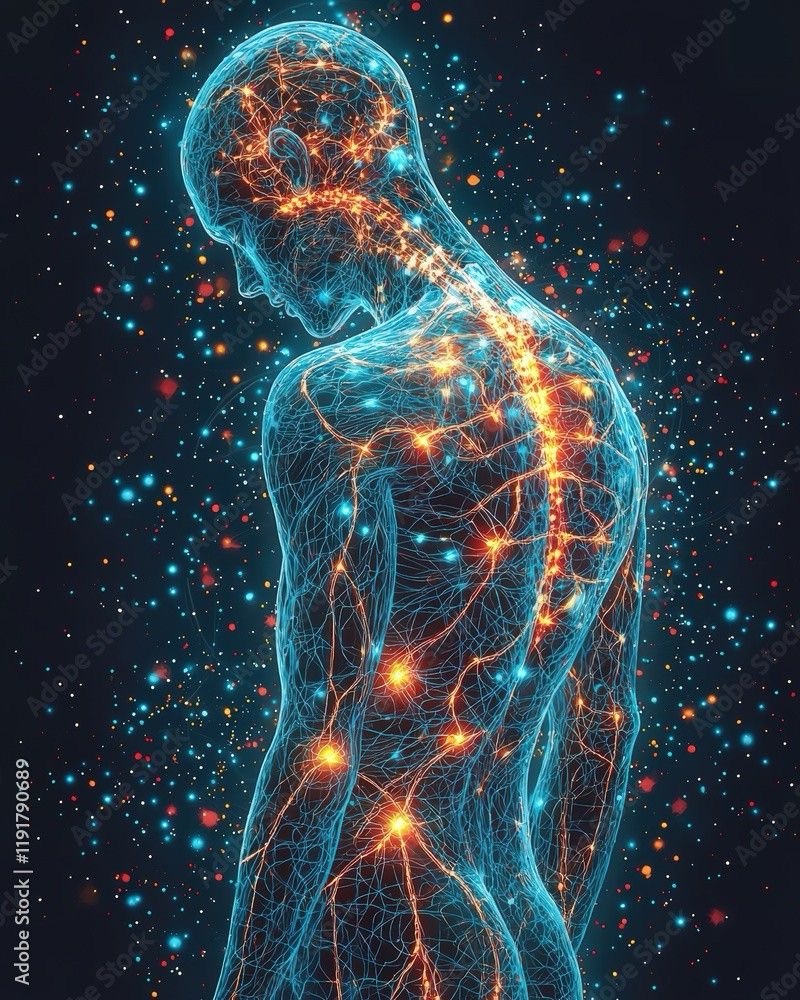
There’s a reason phrases like “high energy,” “good vibes,” and “feeling drained” resonate so deeply—your body is, quite literally, electric. Beneath your thoughts, movements, and emotions lies a constant flow of electrical signals powering everything you do.
This isn’t just poetic language. It’s grounded in biology, chemistry, and physics.
Let’s break it down.
Your Nervous System: An Electrical Superhighway
Your body’s electrical system is driven primarily by the nervous system. Every thought, movement, and sensation is controlled by rapid electrical signals called action potentials.
These signals travel through neurons (nerve cells), allowing communication between your brain and body.
What’s actually happening?
- Neurons maintain a voltage difference across their membranes (called the membrane potential)
- When stimulated, they rapidly shift this voltage
- This creates an electrical impulse that travels down the neuron
These impulses can move at speeds up to 120 meters per second (268 mph)—faster than most cars on a highway.
In simple terms:
Your thoughts are electrical. Your movements are electrical. Your reactions are electrical.
Your Heart Runs on Electricity

Your heartbeat isn’t just a mechanical pump—it’s controlled by an internal electrical system.
The sinoatrial (SA) node, often called the heart’s natural pacemaker, generates electrical impulses that:
- Trigger each heartbeat
- Regulate heart rhythm
- Adapt to stress, movement, and rest
This electrical activity is what’s measured in an ECG (electrocardiogram).
Without these electrical signals, the heart simply wouldn’t beat.
Muscles Fire Through Electrical Signals
Every time you move—even something as small as blinking—electricity is involved.
Here’s how it works:
- Your brain sends an electrical signal through motor neurons
- The signal reaches your muscle fibers
- This triggers calcium release inside the muscle
- The muscle contracts
This process is called neuromuscular activation, and it’s entirely dependent on electrical signaling.
Electrolytes: The Conductors of Your Body

You’ve probably heard of electrolytes in sports drinks—but they’re far more important than hydration marketing.
Electrolytes like:
carry electrical charges that allow your cells to function.
They regulate:
- Nerve signaling
- Muscle contractions
- Hydration balance
- pH levels
Without proper electrolyte balance, your body’s electrical system becomes unstable—leading to fatigue, cramps, or even dangerous heart rhythm issues.
Your Cells Hold Voltage
Every single cell in your body maintains its own electrical charge.
- The average cell membrane potential is about -70 millivolts
- This voltage is essential for transporting nutrients in and out of cells
- It also plays a role in cell communication and healing
This concept is studied in bioelectricity—a growing field exploring how electrical signals influence growth, repair, and regeneration.
Brainwaves: Electrical Patterns of Thought

Your brain produces measurable electrical rhythms known as brainwaves.
These include:
- Delta waves (deep sleep)
- Theta waves (creativity, intuition)
- Alpha waves (calm focus)
- Beta waves (active thinking)
- Gamma waves (high-level processing)
These patterns are measured using an EEG (electroencephalogram).
Different mental states = different electrical patterns.
Why This Matters for Your Daily Life
Understanding that your body is electric isn’t just interesting—it’s practical.
Your energy levels, focus, and overall well-being are directly tied to how well this system functions.
Ways to support your body’s electrical system:
- Stay hydrated (water supports electrical conductivity)
- Maintain electrolyte balance (especially with activity or heat)
- Prioritize sleep (restores brainwave balance)
- Move your body (stimulates neural pathways)
- Reduce chronic stress (prevents nervous system overload)
The Bigger Perspective
When people talk about “energy,” it’s often dismissed as vague or unscientific.
But at a foundational level, your body is a dynamic electrical system:
- Signals firing
- Rhythms syncing
- Charges balancing
You are not just biochemical—you are bioelectrical.
And when that system is supported, everything from your mood to your performance improves.
Final Thought
The next time you say you feel “off,” “drained,” or “energized,” remember—those sensations aren’t imaginary.
They’re electric.
DISCLAIMER
The information provided on this website is for educational and informational purposes only and is not intended as medical advice. Always consult with a qualified healthcare professional before making changes to your health routine.
*This post may contain affiliate links. Read more here.
Leave a Reply